


If you’re learning European Portuguese, Practice Portuguese is one of the few tools I would genuinely recommend to almost everyone.
I first came across Practice Portuguese back in 2012, when I was living in Lisbon for the first time. Back then it was more of a podcast, but I signed up and thought it was genuinely impressive even then. What started as an audio podcast has grown into a full learning platform: a website and mobile app (iOS and Android), structured grammar and vocabulary units from A1 to B2, 700+ audio dialogues, a verb conjugator, community forums, and a Smart Review feature for vocabulary retention.
Practice Portuguese is run by Rui Coimbra, a native Portuguese speaker, and Joel Rendall, a Canadian who moved to Portugal and learned the language from scratch. That combination of native and non-native speaker is genuinely useful: Joel makes the mistakes any of us would make and brings cultural observations that a native speaker would never think to explain, while Rui can answer as a local. That dynamic runs through everything on the platform.
At €15 per month (Portugalist readers pay just €12.75) it’s incredibly affordable, especially given that most other courses cost several hundred euros. That isn’t to say it’s perfect—it falls short in a few places, particularly speaking and writing practice. But I would always have this in my arsenal if I was learning Portuguese, even if I had to complement it with other resources.
Features
The main features on Practice Portuguese:
- The Shorties—Short audio dialogues featuring native speakers in real-life situations, spanning A1 to B2 levels, with transcripts and clickable vocabulary.
- The Learning Studio Units—Structured grammar and vocabulary lessons organized by CEFR level (A1 to B2), with fill-in-the-blank exercises and quizzes.
- Learning Notes—In-depth written lessons covering grammar, vocabulary, culture, and pronunciation in more detail than the units.
- Smart Review—A vocabulary retention system: save words from the Shorties and units, then review via flashcards, quiz mode, or audio-only playlists.
- Podcast & Videos—Longer-form audio and video content hosted by Rui and Joel, covering Portuguese culture and daily life in natural conversational Portuguese.
- The Verb Conjugator—Searchable conjugation tables for around 320 verbs, with audio pronunciation for every form.
- The Community Forum—An active discussion board where learners can ask questions and get detailed replies from the Practice Portuguese team.
- The Built-in Translator—An embedded translation tool that lets you save any word or phrase directly to Smart Review.
The Shorties

The Shorties are short audio dialogues featuring native Portuguese speakers in realistic everyday situations—usually two to five minutes each, with some shorter. There are around 700 of them, spanning A1 to B2 levels. Each comes with a full transcript, vocabulary notes, and the ability to save words and phrases directly to Smart Review.
I’ve looked for comparable listening resources and haven’t found any. There are Portuguese podcasts and YouTube channels out there, and YouTube has gotten significantly better at generating subtitles for Portuguese audio in recent years. But a general Portuguese podcast isn’t built for learners—you can spend more time hunting for content at the right level than actually studying it. The Shorties are purpose-built. The audio is studio quality, every word is clickable and playable at slow speed, and you can add an entire episode’s vocabulary to Smart Review in one click.
A good approach, especially at the start: begin at A1 and A2, listen through each Shortie, and save the words you don’t know to Smart Review. Work through those during spare moments during the day. It keeps what you’re learning anchored to real spoken language rather than a disconnected word list.
A few other features worth knowing: you can toggle the English translation on or off, turn subtitles off entirely and use the Shorties as a dictation exercise, and slow the audio down or speed it up.
One tip for anyone preparing for the CIPLE A2 exam: don’t limit yourself to A2 audio. The Shorties run up to B1 and B2, and it’s worth going beyond your level. The listening component of the A2 exam catches a lot of people out, and having practiced with harder audio makes the actual exam material feel more manageable by comparison.
The Shorties do feature speakers from different parts of Portugal, which is good. That said, more regional variety would be welcome—I get a lot of questions from people planning to move to the Azores, and that accent is genuinely quite different. The ability to filter by accent would be a useful addition.
The Learning Studio (Units)
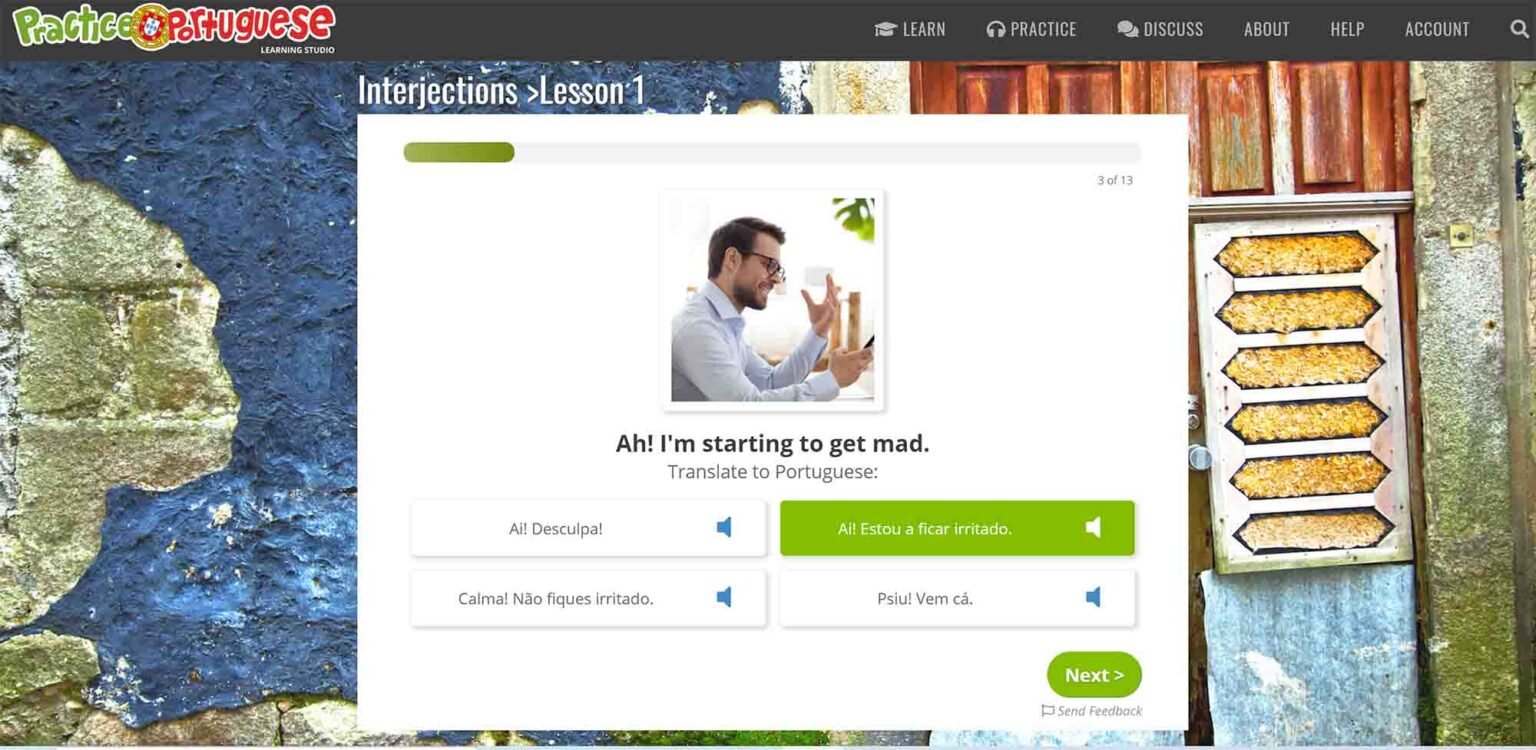
The structured units run from A1 to B2 and cover everything you’d expect: greetings, verbs, grammar, and vocabulary—and then, as you move into A2 and B1, real-life topics like Supermarket, Bank, Hospital and Pharmacy, Post Office, Talking with Neighbours, Renting an Apartment, and Setting Up Utilities.
“Setting Up Utilities” and “Talking with Neighbours” are not topics you’ll find in Pimsleur or most other language courses. They’re exactly what you need when you move to Portugal. Other courses tend to focus on tourist phrases, which still matter, but I like the practicality of Practice Portuguese’s approach.
The full unit list is substantial—well over 100 units, from basic verbs and plurals through to the subjunctive, idioms, slang, and government and politics. There’s a clear learning path with visible CEFR level markers. Unlike Duolingo, where you’re on a fixed conveyor belt, Practice Portuguese lets you jump around and work on what you’re missing—you don’t need to have completed a previous lesson to move to one you’re interested in.
That said, be honest with yourself about what the units are: structured grammar and vocabulary exercises. There’s light gamification—fill-in-the-blank, quizzes—but working through them takes real effort and self-discipline. If you’re used to a teacher walking you through a concept on video and then checking your understanding, you may find this approach cold. The units are more reference and practice than guided teaching, which suits self-directed learners well and suits others less so.
The units also feel somewhat disconnected from the audio content—you’ll work through a grammar point and separately listen to Shorties, but the two aren’t directly linked. It would be better if they were. The B2 section is also noticeably thinner than the A1 and A2 content; the platform’s sweet spot is A1 through solid B1.
Learning Notes
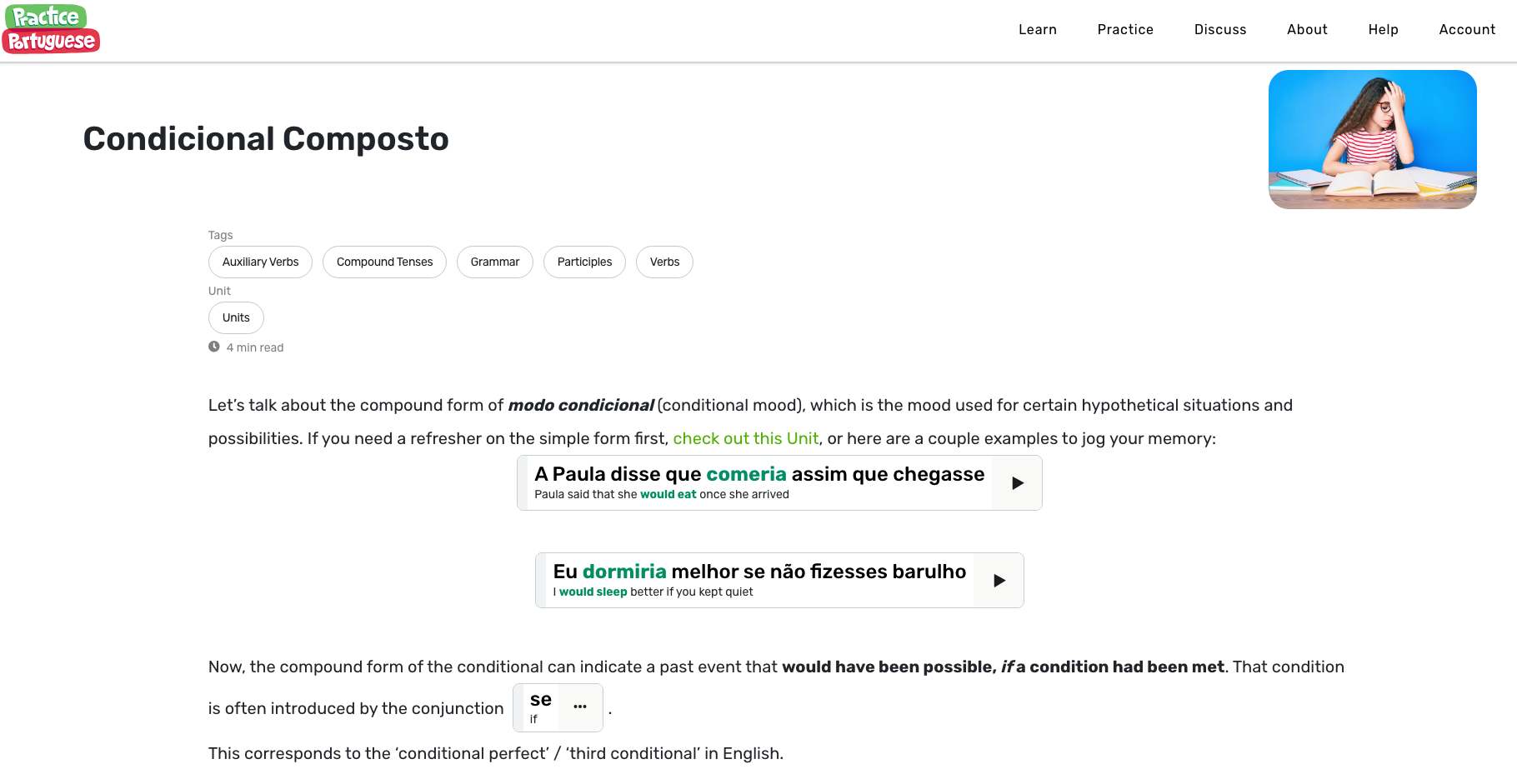
The Learning Notes are where Practice Portuguese goes beyond the bare-bones exercises of the units and into proper explanation. Think of them as the written lessons you’d get in an evening class—except here they’re articles rather than videos. At the time of writing there are more than 200 of them, covering grammar, vocabulary, cultural context, pronunciation, and reader questions in real depth. Topics range from detailed food vocabulary with cultural notes on Portuguese cuisine, to an exploration of the Algarvian dialect, to a thorough guide to preposition pairings. These aren’t quick reference cards—they go into genuine depth.
Most vocabulary throughout the Learning Notes is clickable, with audio pronunciation and instant translation. The one thing that would make them significantly better is the ability to save words directly to Smart Review from within a note—that doesn’t seem to be possible at the moment.
It’s worth noting that the Learning Notes are article-based rather than video-based. A lot of learners today would instinctively prefer video instruction for this kind of content, so if that’s you, it may take some adjustment. But the quality and volume of information here is something most other platforms don’t come close to matching.
The Verb Conjugator

The Verb Conjugator covers around 320 of the most common European Portuguese verbs, with full conjugation tables across all key tenses—present, pretérito perfeito, pretérito imperfeito, futuro, conjuntivo, and more. Crucially, every conjugated form has audio pronunciation, so you’re hearing exactly how each form sounds rather than just reading a table. You can also generate a quiz from any verb to test yourself on its conjugations.
Other tools like Linguno and Conjuegos offer more gamification if you want something that feels more like a game. But I’d start here, because having all the verb tables laid out clearly with audio gives you a solid foundation. Add gamification on top once you have the basics.
Smart Review
Smart Review is the platform’s vocabulary retention system. Save words and phrases from the units or Shorties and review them through flashcards, quiz mode, or audio-only playlists—the latter is particularly good for working through vocabulary while walking or commuting.
I prefer this approach to tools like Memrise or Anki, where you’re often working through abstract word lists. Here you’re learning vocabulary in context, anchored to real dialogues you’ve actually heard. You can also add custom words manually through the built-in translator or the Manage Smart Review page, so anything you pick up elsewhere can be folded in.
What I particularly like: you have genuine control. With Duolingo you can end up cycling through the same words repeatedly. With Smart Review, you add what’s relevant to you and remove it once you know it. And every word on the platform—across both units and Shorties—has been individually recorded by a native speaker. Click any word and you hear exactly how it sounds. For European Portuguese, where pronunciation is genuinely hard for English speakers, that matters.
The Podcast & Videos
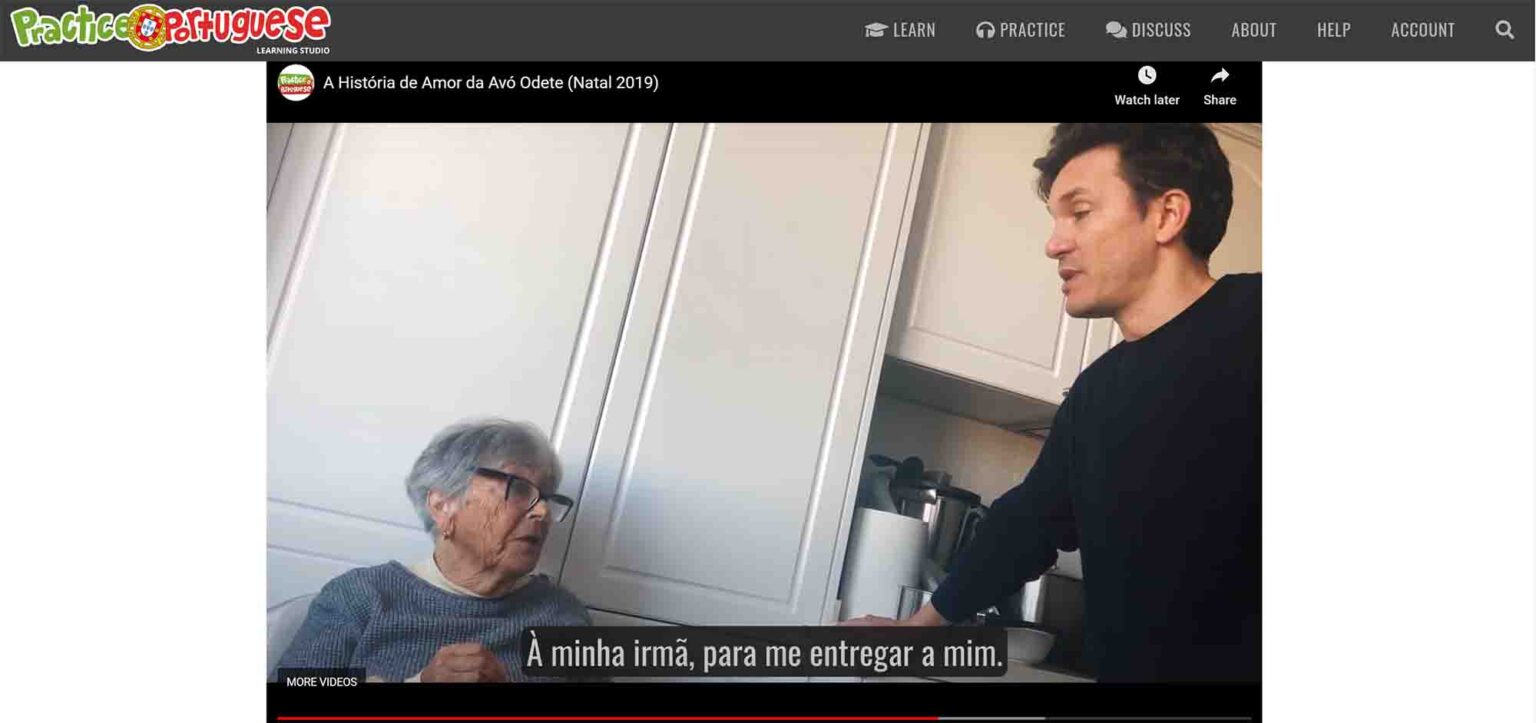
Separate from the Shorties is a longer-form series where Rui and Joel—and sometimes others—go deeper into topics in Portuguese. What started as a purely audio podcast has evolved to include video episodes too. At the time of writing there are around 126 podcast episodes and 17 pages of videos, which means that between all of this and the Shorties, you have an enormous volume of content. If you worked through all of it, you’d be getting exceptional value for money before you even felt the need to look elsewhere.
The podcast episodes run from around eight to thirty minutes and cover ground no other European Portuguese learning platform goes near. Recent topics include “Are You Greeting People Wrong in Portugal?”, “Talking with Neighbours,” “Conversation or Confrontation?” (on the differences between Portuguese and North American conversation styles), “Challenges of Bureaucracy,” and “Adapting to Portugal.” Joel brings the outsider’s observations, Rui provides the cultural context—and you get natural, relaxed Portuguese between two people who clearly know each other well. It doesn’t feel like a classroom.
The videos cover similar ground but add a visual element that works particularly well for vocabulary and real-world content. Some are studio-style conversations—Rui’s bathroom vocabulary, what’s in Rui’s bag, gym vocabulary filmed at an actual Lisbon gym. Others take you out into the city: Joel stopping people on the street to ask where they’re going or what makes them laugh. Those street interview videos are especially worth watching, because you’re hearing real locals speaking at natural speed rather than the carefully recorded studio audio used in most of the content. The difference in sound quality and pace is noticeable—and that’s actually useful, because real-life Portuguese sounds nothing like a studio recording. Getting some exposure to that early is good preparation.
What I find genuinely valuable about both—beyond the language practice—is the focus on daily life and culture in Portugal. It can take a long time to really get to grips with how things work here, and this content gives you a crash course in Portuguese life at the same time as teaching you the language. That combination is rare.
My only real complaint: I wish both were published more regularly.
What It’s Missing
There are two areas where Practice Portuguese isn’t going to be enough on its own: speaking practice and writing practice.
Speaking
You can spend months on units and Shorties, build solid vocabulary, and develop a real ear for how European Portuguese sounds—and still not feel confident opening your mouth. The Learning Studio does give you opportunities to repeat words and phrases aloud, and that’s useful. But you need practice constructing sentences under pressure, responding in real time, and being corrected when you get things wrong. That requires some kind of interaction—ideally a tutor, or at least an AI tool set to European Portuguese.
A good tutor—even once a month or once every couple of months—will catch pronunciation habits and grammar errors you wouldn’t spot yourself. iTalki and Preply are both solid options; expect to pay around €15 to €30 an hour at the lower end. For free options, language exchange partners are possible, and the Practice Portuguese forums are worth checking: members regularly organize conversation practice groups, study partnerships, and in-person meetups. That said, two learners practicing together can reinforce each other’s mistakes, so a native speaker or tutor is always preferable where possible.
Writing
Writing practice is thin. Filling in answers within the units isn’t the same as practicing writing a letter or a message. You can comment on Shorties and post in the forum and you will get feedback from the Practice Portuguese team, which is genuinely helpful—but writing practice needs to go further than this. If you’re preparing for the CIPLE exam, where you’ll need to produce a short message and an informal letter, practice that skill separately with a tutor who can give you feedback.
Price and Value
Practice Portuguese costs €15 per month (€12.75 for Portugalist readers). You can cancel anytime.
That monthly model makes it meaningfully different from courses that require a large upfront payment per level. Some other European Portuguese courses cost several hundred dollars to get through A1 and A2 alone. With Practice Portuguese, you’re getting A1 through B2 content, 700+ Shorties, 126 podcast episodes, the verb conjugator, and Smart Review—all for the monthly fee.
If you work through everything—the units, the Shorties, the podcast, the Learning Notes—you’ll have gotten exceptional value before you feel the need to look elsewhere. One honest note: if you subscribe for two or three years, the total cost starts to compare with some of the pricier upfront courses. The faster you learn and the more consistently you use it, the better the value.
Verdict

I’ve written a lot about learning European Portuguese and reviewed a lot of European Portuguese tools and courses on this site, and most of them have something genuinely good going for them. Learning Portuguese well usually means using more than one—and knowing which gaps each one leaves so you can fill them elsewhere. That’s one of the real challenges of learning a language on your own: you can plateau or develop blind spots without realizing it, and no single tool will point them out.
Practice Portuguese is the platform I’d recommend as the foundation. The audio—the Shorties, the podcast, the videos—is the best European Portuguese listening content available, and listening is both the hardest skill to develop and the one most people struggle with on the A2 exam. The unit structure covers the grammar and vocabulary you need, clearly mapped to CEFR levels. Smart Review makes vocabulary retention easy to fit into your day. And the cultural content—the podcast episodes on bureaucracy, neighbors, greetings, and daily life—gives you something that most other language courses don’t offer.
There are two honest criticisms worth making.
The first is the missing speaking and writing practice, which I’ve covered above.
The second is navigation: because the platform has grown considerably over the years, it can feel a little disconnected at first. The units are front and center when you log in, which is straightforward. But the Shorties, the Learning Notes, the podcast, the verb conjugator—all these things are spread across different parts of the site, and it takes a while to find your way around and build a routine that uses everything. With something like Duolingo or Pimsleur, you just show up and do the next thing. Here, you have to figure out your own structure and keep on top of it. That suits self-directed learners well, but it’s worth knowing going in.
What it won’t give you is speaking confidence or writing practice. For speaking, add a tutor—even occasionally. For writing, practice separately if you’re heading toward the CIPLE.
All of that aside, this is one tool I would absolutely purchase for learning European Portuguese.
 Thinking about Moving to Portugal?