


Forget stuffy classrooms, outdated textbooks, and mind-numbing printouts. These modern courses are a far cry from traditional language classes. They’re flexible, engaging, and designed to fit around real life (work, kids, moving paperwork, and the occasional existential spiral about Portuguese pronunciation).
Whether you’re planning to retire in the Algarve, study in Coimbra, or just want to pass that all-important A2 exam for citizenship, there’s a course out there for you. The trick is picking the right one—because “best” depends on how you learn and what you actually need Portuguese for.
Quick note on certification: These courses do not offer certification (e.g. the A2 or CIPLE, which is the lowest option for citizenship). You will need to study (i.e. with one of these courses) and then book the exam separately. You can sit the exam in Portugal or multiple countries worldwide, including the UK, US, and Canada.
Practice Portuguese
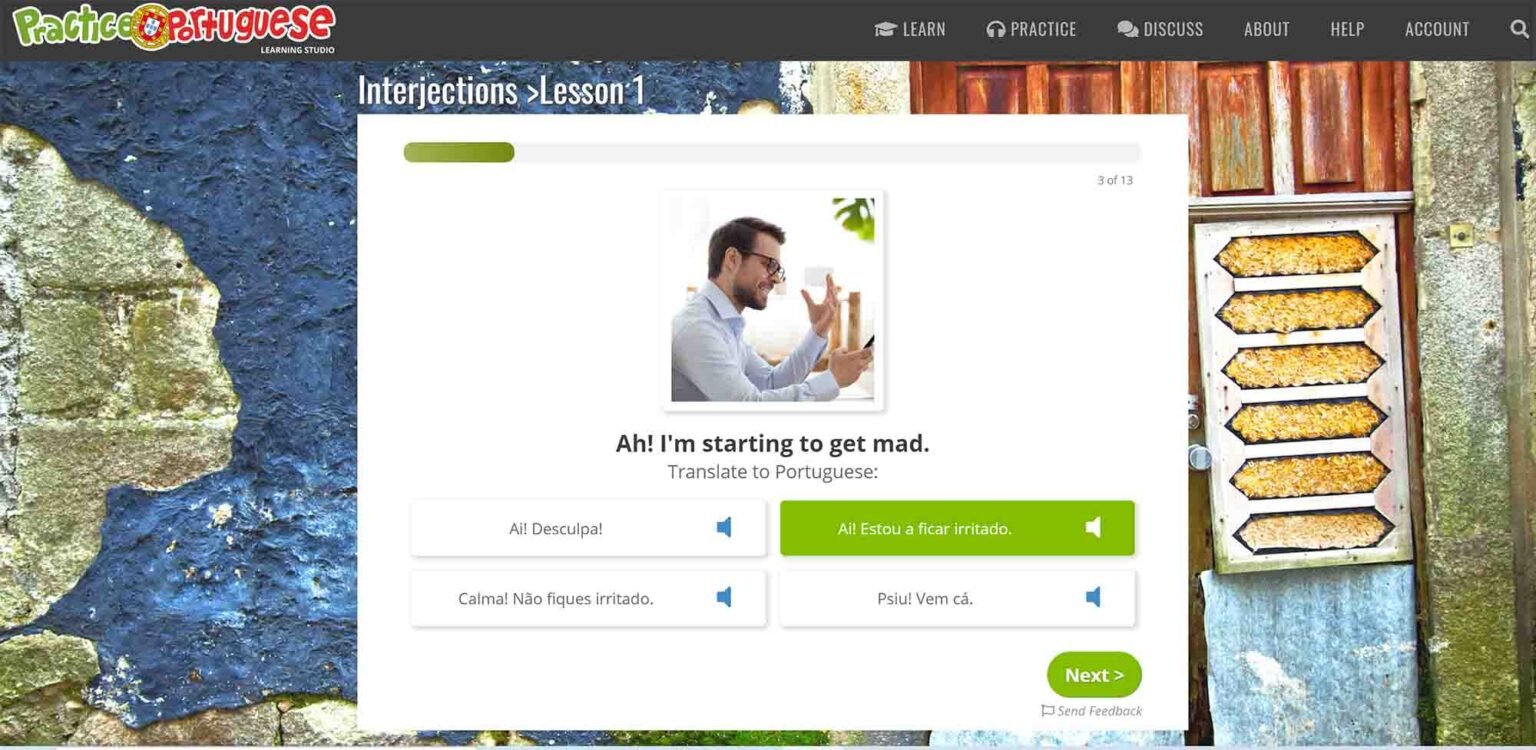
Practice Portuguese started as a podcast, but today it’s a full-blown language learning platform (desktop + mobile) focused entirely on European Portuguese. It’s a strong “all-in-one” option: grammar, vocabulary, listening practice, and lots of everyday Portuguese that actually sounds like Portugal.
One standout feature is the audio content. If you’ve ever wished you could eavesdrop on real Portuguese conversations (without feeling creepy), the “shorties” are exactly that: bite-sized dialogues that train your ear for how Portuguese is spoken in real life. They’re quick, practical, and perfect for busy days.
Now, here’s the kicker: at just €12.75 per month (wink wink, just for Portugalist readers), it’s a steal. Even if you use another “main” course, this is the kind of platform that can quietly become your secret weapon—especially for listening.
- Levels: A1, A2, B1, B2, plus some C1 content
- Best for: Learners who want a balanced platform (listening + grammar + practical Portuguese)
- Type: App/web platform with lots of audio and some video
- Cost: €12.75 per month
- Buy it: PracticePortuguese.com
Portuguese Pro
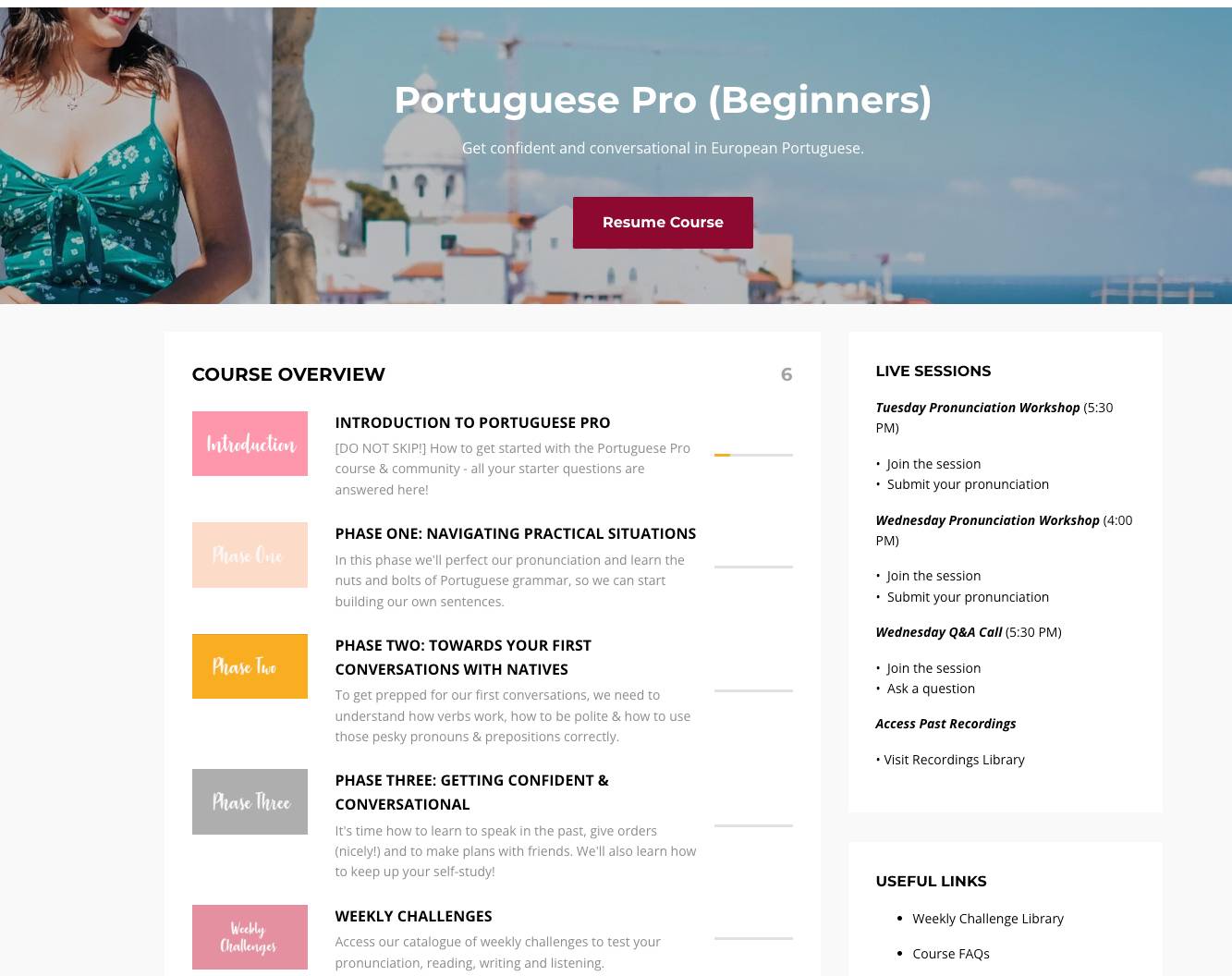
Portuguese Pro is created by Liz Sharma, the face behind the popular Talk The Streets YouTube channel.
The course is very pronunciation-led, which is a big deal for European Portuguese. Liz focuses heavily on helping learners understand fast, real-world Portuguese and be understood by locals, without drowning you in grammar rules or textbook-style exercises . The aim is simple: get you conversational as quickly as possible.
(You can get a feel for the course by signing up to her next introductory webinar).
Students get access to a private group with live workshops, feedback, and encouragement — something many learners find helps with confidence and consistency far more than solo apps. There’s also a light-hearted progress milestone: graduates who send in a 10-minute conversation with a native speaker at the end of the course earn the “Sou Pro” badge (and mug).
This is a premium course, both in price and in approach. It’s designed for learners who want real progress — and are willing to invest to get there.
- Levels: A1–A2
- Best for: Learners who want fast, practical speaking confidence and clear pronunciation
- Type: Online course with videos, weekly live workshops, and community support
- Certification: No – The course equips you to pass the CIPLE A2 exam with dedicated modules and practice exams and guidance but you will still need to book and sit the exam itself.
European Master Course (Learn Portuguese with Mia)

If you learn best by watching and listening (instead of tapping through app exercises), Mia’s courses are a great fit. The format is video-first and feels more like a guided class. Lessons include vocabulary, phrases, quizzes, and little interactive elements that keep things moving.
This is especially good if you like structure and you want to be taught step-by-step. And if pronunciation is a priority, her Speech Course is a smart add-on for getting closer to how European Portuguese actually sounds.
- Levels: A1, A2, B1, B2
- Best for: Video learners who want a clear progression and teacher-led lessons
- Type: Online streaming video lessons
- Cost: $399 + tax (approx) for a bundle (e.g., A1 & A2)
- Discount: 15% off with this link or code 15PORTUGALIST
- Buy it: learn-portuguese.org
The Journey (Portuguese with Carla)

If you hate “language learning” but love stories, this is the course that sneaks Portuguese into your brain while you’re busy following a plot. You’re learning through an ongoing story (Carla searching for a mysterious letter from her father), with videos and quizzes that build your comprehension as you go.
It’s also great if you need momentum. A story gives you a reason to come back tomorrow, which is half the battle with Portuguese.
- Levels: Not stated clearly, but likely A1–B2
- Best for: Story-based learners who want immersion without the boredom
- Type: Streaming videos + quizzes
- Cost: €29/month or €349/year
- Buy it: PortugueseWithCarla.com
Michel Thomas Total Portuguese

Michel Thomas is an old-school favorite for a reason: it gets you building sentences fast. It’s audio-first, and it teaches you how the language works (especially grammar and structure) through guided repetition with “classroom” style listening.
The tradeoff is that it’s not really designed to teach reading and writing, and it won’t give you the same volume of modern listening content you’d get from a platform like Practice Portuguese. But if your brain likes patterns and structure, this is a very efficient way to start.
- Levels: Foundation Portuguese, Intermediate Portuguese
- Best for: People who want to understand grammar and sentence-building quickly
- Type: Audio course
- Cost: ~ $152
- Buy it: MichelThomas.com
Pimsleur’s European Portuguese

Pimsleur is made for busy people. It’s audio-based and designed to be done while walking, driving, cleaning, or doing anything where you can listen and respond. The method leans heavily on recall (not just passive listening), which is why it works well for building speaking confidence.
The downside is that the European Portuguese course doesn’t go very far compared to some other options. It’s a strong starter, but most learners will need a “next step” afterward.
- Levels: Level 1
- Best for: Total beginners who want speaking confidence fast (and prefer audio)
- Type: Audio course
- Cost: $20.95/month
- Buy it: Pimsleur.com
Portuguese Lab Academy
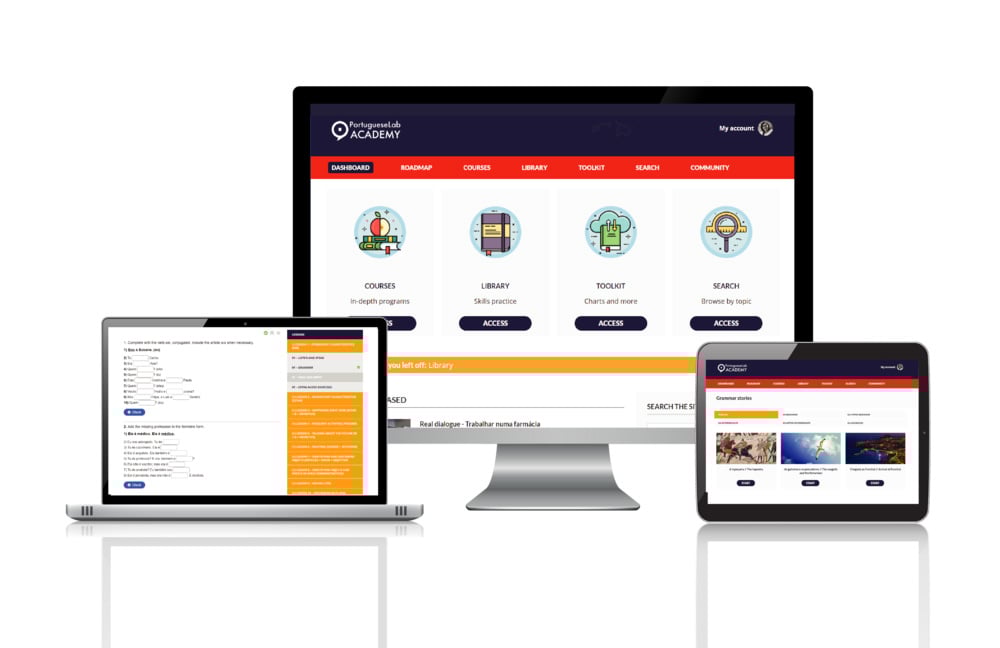
Portuguese Lab Academy is a structured online learning program that mixes lessons with dialogues, quizzes, vocabulary flashcards, and grammar exercises. It’s a solid choice if you want a clear progression and you like “course-style” learning rather than an app that feels like a game.
- Levels: A1, A2, B1, B2
- Best for: Learners who want a systematic path with lots of exercises
- Type: Web app / online academy
- Cost: $35/month or $350/year
- Link: portugueselabacademy.com
Plataforma de Português Online (PPT Online)

This is the best-known free option: a government-backed platform covering European Portuguese from A1 through B2. For a free resource, it’s surprisingly complete. The main downside is usability: it can be slow, and sometimes it simply doesn’t work when you want it to.
Think of PPT Online as a helpful support resource (especially for vocabulary and structured practice), rather than your only learning method. If you’re serious about progressing quickly, pairing it with a paid course or weekly tutoring is usually more effective.
- Levels: A1, A2, B1, B2
- Best for: Budget learners and anyone who wants extra structured practice
- Type: Web app
- Cost: Free
- Link: pptonline.acm.gov.pt
Camões Institute E-Learning
If you want something more formal and academic (and you don’t mind it feeling less “modern app” and more “serious study”), the Camões Institute offers distance-based Portuguese courses. Some options are self-study, while others include interaction with a tutor.
They also offer Portuguese for specific purposes, which can be useful if you need work-related language, business Portuguese, or more advanced writing-focused study.
- Levels: A1, A2, B1, B2, C1
- Best for: Learners who like formal instruction and higher-level pathways
- Type: Distance learning (some options include tutor support)
- Certification: No, you’ll need to book the exam (typically A2 for citizenship) separately.
- Cost: €180–320 per level
- Link: instituto-camoes.pt
Distance Learning from the University of Coimbra
University-run courses can be a great way to access higher-level Portuguese (especially C1), which is often harder to find through mainstream apps and platforms. Coimbra’s distance learning options typically run during the academic year and can be a good fit if you want something more structured and classroom-like.
- Levels: A1, B1, B2, C1
- Best for: Learners who want academic rigor or need C1 options
- Type: Distance learning
- Link: ed.uc.pt
Textbook-Style Courses (Good if you want reading & writing)
- Get Started in Portuguese (Teach Yourself)
- Levels: A1–A2
- Type: Book + audio
- Cost: ~ $30
- Best for: Absolute beginners who want a structured, offline-friendly course
- Passaporte para Português
- Levels: A1–B1 (two books: A1/A2 and B1)
- Type: Textbook(s)
- Cost: ~ $45 (varies by seller)
- Best for: People who want a clear, structured “study plan” to reach B1
- Ponto de Encontro: Portuguese as a World Language
- Levels: Not CEFR-labeled (often used in university courses)
- Type: Textbook + Pearson MyLab access (via access code)
- Cost: ~ $150 with online access (book alone is often much less)
- Best for: Academic-style learners (note: not specifically Portugal Portuguese)
- Colloquial Portuguese: Beginner’s Course (Routledge)
- Levels: Beginner (likely around A1)
- Type: Book + audio (CD/MP3 depending on edition)
- Cost: ~$43 / £34
- Audio (if your edition doesn’t include it): Routledge textbook audio page
- Português em Foco
- Levels: A1–A2
- Type: Textbook + audio (CD)
- Cost: ~ $36 (often varies; can be out of print)
- Best for: Traditional A1/A2 textbook learners
- Dialogar em Português
- Levels: A1–A2
- Type: Textbook + audio (CD)
- Cost: $32 / £25
- Best for: Everyday-situations Portuguese (shopping, transport, eating out)
- Olá! Como está?
- Levels: A1–B2
- Type: Textbook pack + audio (CD)
- Cost: ~ £43
- Best for: A longer runway (A1 through B2) in one course series
- Aprender Português (A1/A2)
- Levels: A1–A2
- Type: Textbook + companion materials (often with audio/CD depending on package)
- Cost: ~ $50 (varies)
- Aprender Português (B1)
- Levels: B1
- Type: Textbook + companion materials
- Aprender Português (B2)
- Levels: B2
- Type: Textbook + companion materials
- Avançar em Português (B2)
- Levels: B2
- Type: Textbook + audio (CD)
- Cost: $14 / £25
- Best for: Learners bridging into upper-intermediate Portuguese
- Português Atual 1 (A1/A2)
- Levels: A1–A2
- Type: Textbook + audio (CD)
- Cost: ~ $33 per level (varies)
- Português Atual 2 (B1/B2)
- Levels: B1–B2
- Type: Textbook + audio (CD)
- Português Atual 3 (C1/C2)
- Levels: C1–C2
- Type: Textbook + audio (CD)
- Best for: One of the few textbook series that keeps going past B2
Other Resources (These pair well with any course)
Most people learn faster when they combine a structured course with one extra thing: either tutoring (for speaking) or a vocab/listening add-on.
- iTalki – Find European Portuguese tutors for one-on-one lessons or pure conversation practice. (Preply and Verbling are similar.)
- HelloTalk – A language exchange app where you can chat with native speakers and get corrections.
- Memrise – A strong option for vocabulary and phrases (many learners prefer it to Duolingo for practical language).
- Drops – Great for quick vocab practice when you only have a few minutes.
And just to save you time: Duolingo is popular, but it teaches Brazilian Portuguese—not European Portuguese—so it’s not the best match if your goal is Portugal.
Booking The Course
Which course is best?
There’s no perfect course. The “best” choice depends on your goal and learning style. If you want an all-in-one platform, start with Practice Portuguese. If you want video lessons, Mia’s courses are great. If you need something you can do while walking or driving, look at Pimsleur or Michel Thomas.
Which courses are free?
The most popular free structured course is Plataforma de Português Online (PPT Online). It covers A1–B2, but the site can be slow. Most learners get the best results by using it as a support resource alongside a paid course or a tutor.
Taking The Exam
At some point, all the apps, videos, and pronunciation drills have to meet reality: you’ll need to book and sit an official Portuguese exam. The important thing to know is that exam places — especially for the A2 (CIPLE) — are limited and fill up quickly. Registration usually opens in January, and popular A2 dates in Portugal often sell out by late spring. Leave it until the last minute and you may find yourself ready for citizenship but unable to secure an exam slot.
Because A2 is the minimum level for citizenship, it has the highest demand and the fewest seats. B1 and B2 exams usually have more availability, and many learners find they naturally reach low-B1 level by the time they’re approaching citizenship anyway. For that reason, some people choose to study to B1 and book that exam instead — not because it gives extra citizenship benefits, but simply because it’s easier to secure a place.
You don’t have to sit the exam in Portugal. CAPLE exams run in many countries including the UK, US, Canada, Australia, South Africa, and across Europe. If A2 slots are full in your country or in Portugal, it’s also common to look in nearby countries with lower demand — Spain, for example, often has better availability.
Finally, don’t leave this until year four or five of residency. The calmest path is to book an exam date well in advance, then study toward a real deadline. It avoids panic later — and turns the exam from a last-minute hurdle into just another planned step on the journey.
Final Thoughts
Learning Portuguese isn’t about becoming perfect. It’s about becoming comfortable enough to live your life here — chatting to neighbours, handling appointments, reading signs, and eventually ticking off that language requirement for residency or citizenship. The good news is that there’s no single “right” way to learn. Some people thrive with apps, others need video lessons, tutors, or story-based courses. What matters is finding a method you’ll actually stick with, not the one that looks best on paper.
And remember: the exam is just a milestone, not a verdict on your intelligence or your accent. Book it early, study a little beyond the minimum, and give yourself time to grow into the language rather than racing toward it at the last minute. Do that, and Portuguese stops being a barrier — and starts becoming one of the most rewarding parts of living in Portugal.
 Thinking about Moving to Portugal?
Comments are closed.