


Wondering whether you’ll be able to binge-watch your favorite shows or video-call the family back home without buffering? Good news: Portugal has some of the fastest, cheapest, most widely available internet in Europe. I run this site, I work online all day, and I care about this more than is probably healthy—so here’s my honest take.
I’ve watched the internet here go from genuinely terrible to genuinely excellent. In the early days, especially in rural areas, it was grim: you’d buy a dongle with about 3 GB on it and burn through the lot after a few YouTube videos. Even a few years ago, getting fiber in the countryside was a real struggle.
That’s changed. Mostly.
Today, in most towns and cities, you can assume the same kind of connection you’d expect anywhere in Europe—often gigabit fiber for a fraction of what you’d pay in the US or Canada. Mobile coverage is strong across the country too. I’ve driven through parts of the rural US where the signal simply vanishes for miles; I notice that far less here.
But good coverage nationally doesn’t mean coverage everywhere. In the UK or US you can punch your address into a comparison site and get a straight answer. Portugal doesn’t work like that: the checkers tell you what’s available somewhere in your postcode, not necessarily on your street or in your building.
So before you fall in love with a house, check what’s actually there.
That’s exactly what we do at Portugalist. Fill out the form below and our team will check what’s genuinely available at your specific address—which providers, which speeds, fiber or not. It matters most in rural areas, but it’s useful in cities too, where the answer can change from one street to the next.
Check Internet Options At Your Property
How this compares to home
If you’re coming from the US, this is one of the genuinely uncomplicated upgrades of moving here.
Gigabit fiber runs somewhere around €30–40 a month. The average American home internet bill is about $80, and the US sits near the bottom of the global table on price. Fiber reaches roughly 92% of Portuguese homes; in the US it passes a bit over 60%, and only around one broadband line in seven is actually fiber.
The one thing I won’t oversell is raw speed. Measured speeds in the US are strong too, so this isn’t “Portugal is faster than America.” It’s that fast fiber here is normal, cheap, and available almost everywhere.
Against the rest of Europe, Portugal is near the very top for one thing in particular: fiber availability. Only a handful of countries—Malta, Romania, Spain—really beat it, while the EU average sits closer to 80% and some big Western European countries are far lower.
What I wouldn’t claim is that it’s the cheapest in Europe, because it isn’t. Eastern Europe undercuts it easily; Romania has some of the lowest prices in the world. Portugal is a little cheaper than most of Western Europe and gives you more speed per euro than almost anywhere. That’s the honest version of “great value.”
(UK and Canadian readers: you’re not coming from as far behind as Americans. UK prices are lower, and Canada’s fiber reach is close to Portugal’s. You’ll still get more top-end speed for your money here.)
Fiber: the good stuff, and where you can get it
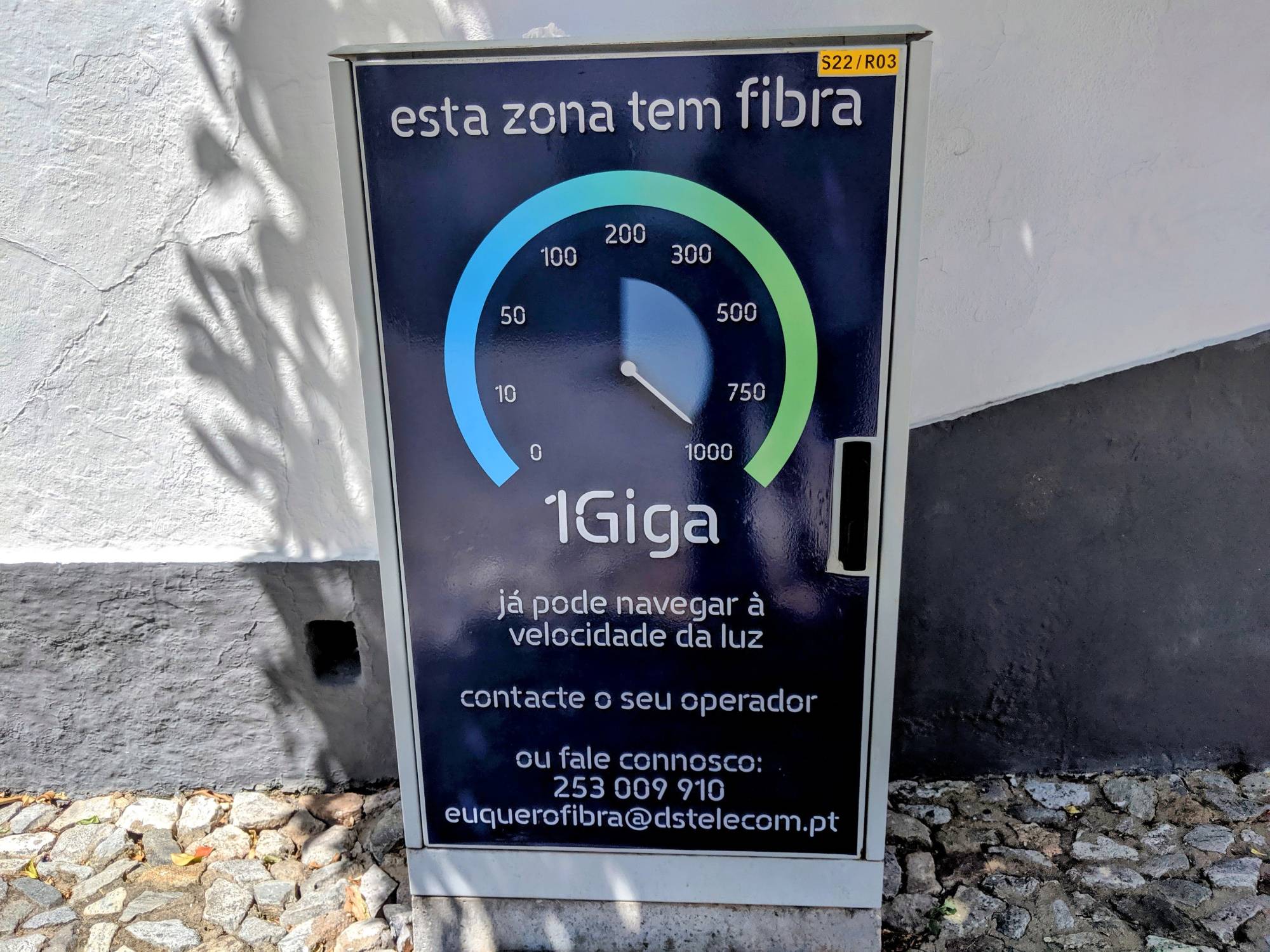
Fiber-optic internet—fibra or internet fixa in Portuguese—is available throughout Portugal, in cities, towns, and increasingly rural areas. Where you can get it, expect speeds up to 1 Gbps as standard, with 2 Gbps and even 10 Gbps available in a lot of places now.
In plain terms: as long as fiber reaches your home, you’ll get internet as fast as anywhere in Europe. Plenty of Americans tell me their home and mobile internet is dramatically better here than what they left behind.
The uploads are worth a mention too. Portuguese fiber is symmetric—the same speed up as down—which a lot of US and UK connections still can’t manage. If you back up large files, upload video, or live on calls, you’ll feel that more than the headline download number.
What it costs (roughly), and how fast you actually need
Prices move every month, so treat these as estimates, not quotes. The short version: it’s cheap, and the gaps between the tiers are small.
500 Mbps—around €30. This is the floor now that the old 200 Mbps plans have disappeared, and honestly it’s where most people should stop. Streaming in 4K, working from home, a few people online at once—500 handles all of it without you ever thinking about it.
1 Gbps—around €40. I’d nudge most people here anyway. It’s not much more, and the extra headroom buys you stability when the whole house is online at once—which you notice far more than the raw speed number. At that price it’s an easy yes.
2 Gbps—around €50. For creators, serious gamers, and households with more devices than Portugal has sardines. A few years ago this tier didn’t exist for normal customers.
10 Gbps—around €60. Overkill for almost everyone, and I’m only including it because the price is remarkable: this was a €100 curiosity a couple of years ago and it’s now exceptionally cheap for what it is. The catch is availability—10 Gbps is mostly an urban thing, so you’d need to check it’s actually offered at your address before getting excited. If you move enormous files for a living, it’s there.
Whatever you pick, the number that actually matters isn’t in this list. It’s whether any of it reaches your exact address—the one thing the price pages won’t tell you honestly. That’s what the form at the top checks.
Do you even want a bundle?
Here’s what’s going on behind the pricing. The three big networks—MEO, NOS, and Vodafone—are in a fight with the low-cost operators, and the way they’re fighting it is speed and hardware: bigger download numbers, symmetric uploads, and new Wi-Fi 6 and Wi-Fi 7 routers thrown in. That’s why the entry plan jumped from 200 to 500 and gigabit became the default. Good time to be the customer.
But a lot of people arriving here assume they need the full package—internet, TV, a landline, and mobile, all on one bill. Most don’t. You’re probably not going to watch Portuguese TV, you’ll make your calls on WhatsApp like everyone else, and if you’re renting for your first year you may not want a two-year contract at all.
So the real question usually isn’t which bundle. It’s just: do you want the fastest, best-equipped connection the big networks are competing to hand you, or the simplest, cheapest one that does the job? Both are fine. If you work online, live on video calls, or hate buffering, I’d take the big-network fiber and the better router. If you mostly browse and stream, the cheaper, simpler route is the sensible one—more on that below.
The providers: MEO vs. NOS vs. Vodafone vs. Digi
Ask ten people which provider is best and you’ll get ten answers plus a few burning grudges. Here’s how I’d actually think about it.
They’re all fine if they can give you fiber. That’s the real test—not the brand on the router. Where fiber’s available, the differences between them are small.
MEO (say it like “mayo,” but don’t put it on a sandwich) is the biggest network, with the best rural reach thanks to its legacy copper-and-fiber footprint. If you’re not sure where you’ll end up, it’s the safest bet on coverage.
NOS is a solid option and often a touch cheaper.
Vodafone is the only multinational in the market and the one expats most often single out for customer service. People used to say it was clearly ahead; I think the others have largely caught up, but it’s still a strong, reliable choice.
Digi is the newcomer, and it’s the reason everyone else’s prices came down. Romanian-owned, it launched here and undercut the whole market—standalone gigabit fiber lands around €29 with no long contract, and its promotions can drop as low as about €10 a month, which is the kind of number that makes the big three very nervous. It asks for just a three-month commitment on fiber, versus the 24 months the incumbents want, and it bought NOWO, the old coaxial operator, in 2024.
The trade-off is the one you’d expect from the cheapest option: customer service is thinner and mostly online—there aren’t really stores to walk into—and coverage is patchier outside the bigger towns, with no official coverage map, so you have to run their checker. But they’re growing fast, and for a lot of people the price and the three-month contract more than make up for the rougher edges.
One thing worth knowing if you run a home lab, a VPN, or anything that needs a stable public IP: budget operators often put many customers behind one shared public IP, which can occasionally trigger odd website blocks or captchas because of what a stranger sharing that IP is doing. For most people it never matters; for some it does.
And a rule of thumb: if Digi fiber is available at your address, there’s a good chance other low-cost operators are too—so it’s a sign you’ve got real choice, not just the big three.
Which one would I tell a newcomer to get?
If you’re renting and might move within a year or two—which describes a lot of people arriving on the D7 or D8, who often rent for the first year before deciding where to actually settle—you’ve got two sensible routes:
MEO, because it’s the largest network and most likely to have fiber wherever you move next. On a two-year contract you can carry your connection to the new address for a small install fee (around €25–50) with no break penalty.
Digi, if it covers you, precisely because the contract is only three months. If you genuinely don’t know where you’ll be in six months, not being locked in for two years is worth a lot.
If you’re buying and know you’ll be there a while, you’ve got the freedom to pick whichever of the four gives you the best fiber deal at your address.
There are also small regional players. In the Algarve, for example, Lazer offers fiber around Faro and the eastern Algarve—great if you live in its patch, irrelevant if you don’t.
A note on English-language support
No provider has a dedicated English helpline, and support quality varies.
- Vodafone is the one expats most often recommend—it has an English help page and will handle issues by email in English.
- MEO and NOS both have English-speaking agents, but you may wait, and navigating the Portuguese phone menu to reach them is its own small adventure.
- Digi, being the budget option, has the thinnest support of the four. All of them have English-language websites, and if you hit a wall, English is widely spoken here—they’ll usually find someone.
Location is everything
- The city advantage. Moving to a decent-sized town or city? You’re in luck—fiber in populated areas is about as common as the cafés on every corner, and just as fast.
- The postcode trap. This is the big one. Just because your area is listed as having “high-speed internet” doesn’t mean your exact house is covered. Online checkers are notoriously optimistic, and it’s common for the cables to reach a mile or two short of where the map implies.
- Street by street. A provider might serve one street and not the next one over.
- Apartment blocks. In a block you’ll usually have a choice of just one provider—rarely all of them.
This is why we push people to have their actual address checked rather than trusting a postcode result. Here’s a reader who learned it the hard way:
The cable instalment seems to be pretty tough even in Coimbra city center. My wife and I recently relocated here from the Tokyo metropolitan area. The first thing we did was seal the contract with one of the telecom companies here. We’d waited more than three months in vain when they abruptly informed us the cable wasn’t available around our area, shutting out our 4G connectivity altogether. We wish we’d read this information much earlier.—Takashi, Portugalist reader
The Azores and Madeira
I’ve been to all nine islands of the Azores, and I was pleasantly surprised: mobile coverage was generally good, and so was the fixed broadband. Fiber is widely available across both archipelagos, and—bonus—lower VAT makes it a little cheaper than the mainland.
Two honest caveats. There were patches on the islands where the mobile signal wasn’t great. And the very top speed tiers are more of a mainland, big-city thing—Madeira has the lowest fiber take-up of any region in the country. If getting the fastest possible fiber matters to you out there, have your address checked first.
Bundling: only for what you’ll actually use
Bundling internet, TV, mobile, and a landline together can be cheaper—but only if you were going to use all of it. Paying for a TV package and a landline you’ll never switch on, to “save” on the internet, isn’t saving. It’s the oldest trick in the telecoms book.
For most newcomers the honest version is: decide internet and mobile separately, and skip the TV and landline unless you specifically want them.
Where bundling still earns its place:
- Mobile. You’ll want a plan anyway, and adding it to your internet is often cheaper than buying it alone. With the big three both usually run two years, so starting them together makes sense—unless you’re going the short-contract route, in which case keep them apart.
- Family plans. One plan for everyone is cheaper and often multiplies the data. Ask for four SIMs with 10 GB each and providers frequently pool it, so everyone effectively shares 40 GB at the 10 GB rate.
Thinking about prepaid instead? Fine too. Just know that some “unlimited” prepaid plans quietly throttle after 100–200 GB, and every provider’s “unlimited” has a fair-use clause buried in the small print. If you truly want unlimited, a contract is the safer bet.
The contract question
Two-year contracts are the norm with the big three, but don’t let that scare you off. If you need to move, you have options:
- Take it with you. Small install fee at the next place (around €25–50), no break penalty—but your two-year term restarts.
- Pass it to the next tenant like a digital housewarming gift.
- Keep paying it out—sometimes cheaper than the exit fee.
Want something shorter? MEO offers a one-year contract, though shorter terms usually mean higher tariffs and no free setup. And Digi asks for just three months on fiber—the most flexible option on the market if you’re not sure how long you’ll stay.
What you’ll need to get connected
Before you start, have these ready:
- An address in Portugal.
- Proof of address—rental contract, utility bill, promissory contract, or property deeds.
- A NIF (tax number—think of it as your Portuguese ID for admin). Don’t have one? [Get your NIF here.]
- A Portuguese bank account. You can pay from a foreign account via IBAN, but it’s often more hassle and can add a few euros a month. No account yet? [Get your Portuguese bank account here.]
When fiber isn’t an option
No fiber at your address? You’ve got backups that don’t involve camping in the local café’s Wi-Fi.
4G/5G home internet. A router at home on the mobile network is genuinely good for most things—browsing, WhatsApp, Netflix. It’s not as fast as fiber, and you’ll occasionally hit buffering on video calls, but it’s usually more than serviceable. Digi even offers a 5G home-internet stopgap for around €5/month while you wait for its fiber to reach you.
Mobile Wi-Fi hotspots. Fine for light users—okay speeds on short (usually 30-day) contracts, good enough for messaging, browsing, and some streaming, depending on your signal.
Starlink. When all else fails, look to the sky (and hope there isn’t a building in the way). It tends to be faster and more reliable than 4G home internet, with no long contract. The downsides: a higher up-front hardware cost, and—for some people this matters—your money goes to Elon Musk. If that’s a dealbreaker, 4G home internet is the alternative.
Before committing to any of these: grab prepaid SIMs from MEO, Vodafone, and NOS, see which has the best signal at your place, and sign up with that one for home internet. When you’re relying on mobile broadband, finding the right network for your exact spot is the whole game.
Improving a weak connection
A common gripe: the internet doesn’t reach the whole house. This is classic in older Portuguese homes with big, thick stone walls.
Picture it—you’ve moved into a charming old farmhouse. The views are spectacular, the wine cellar’s full, and the Wi-Fi is playing hide and seek. A Wi-Fi repeater, or a mesh system, acts like a megaphone for your signal, pushing it into every corner of the house. It’s a cheap fix that makes a big difference.
FAQs
Will prices go up? By law, providers can raise prices annually with inflation, so expect small increases. One nice exception: Digi has said its prices won’t rise with inflation.
Do I need to speak Portuguese to set up internet? Most companies don’t have dedicated English lines, but English is widely spoken and they’ll usually find an English-speaking colleague. We also work with a telecommunications broker who’s fluent in both English and Portuguese and can do all the Portuguese speaking on your behalf.
Is there a single “best” provider? If you can get fiber, they’re all good. The best provider is the one that reaches your address—use the form above and we’ll check.
How long does installation take? In big cities, often 2–3 days (sometimes same-day in Lisbon). Rural homes can take up to a week. And if the connection box is full, it can be a 1–2 week wait for them to add capacity.
Can I use a foreign bank account? It’s a mixed bag. MEO accepts a foreign IBAN (sorry, US banks). NOS wants a Portuguese account. Vodafone accepts foreign accounts but it’s a little more complicado. Wise and Revolut accounts, with their European IBANs, tend to work smoothly. But if you live here or own property, a local account makes the most sense.
 Thinking about Moving to Portugal?