


I first came across Liz Sharma when she started posting YouTube videos of herself stopping people on the streets of Lisbon, asking them something ordinary, and posting their answers with subtitles.
At the time, natural European Portuguese with subtitles was very hard to find. You could watch the news, but you would never understand what was going on. To actually be able to listen and read along was a real novelty, especially to Portuguese as it’s spoken in real life.
So I was excited when she built a full course around the same idea. I’ve been through Portuguese Pro myself, and it’s one of the best European Portuguese courses I’ve come across for getting you to actually speak.
It’s also ideal for those who are planning to sit the A2 CIPLE exam and are nervous about passing. It’s the only course I found with a full mock exam that includes feedback on all four parts: reading, writing, listening and speaking.
But I would say this course goes beyond just exam prep. It’s built for people who really want to speak Portuguese, communicate in Portugal, and make the most of their time here.
🎥
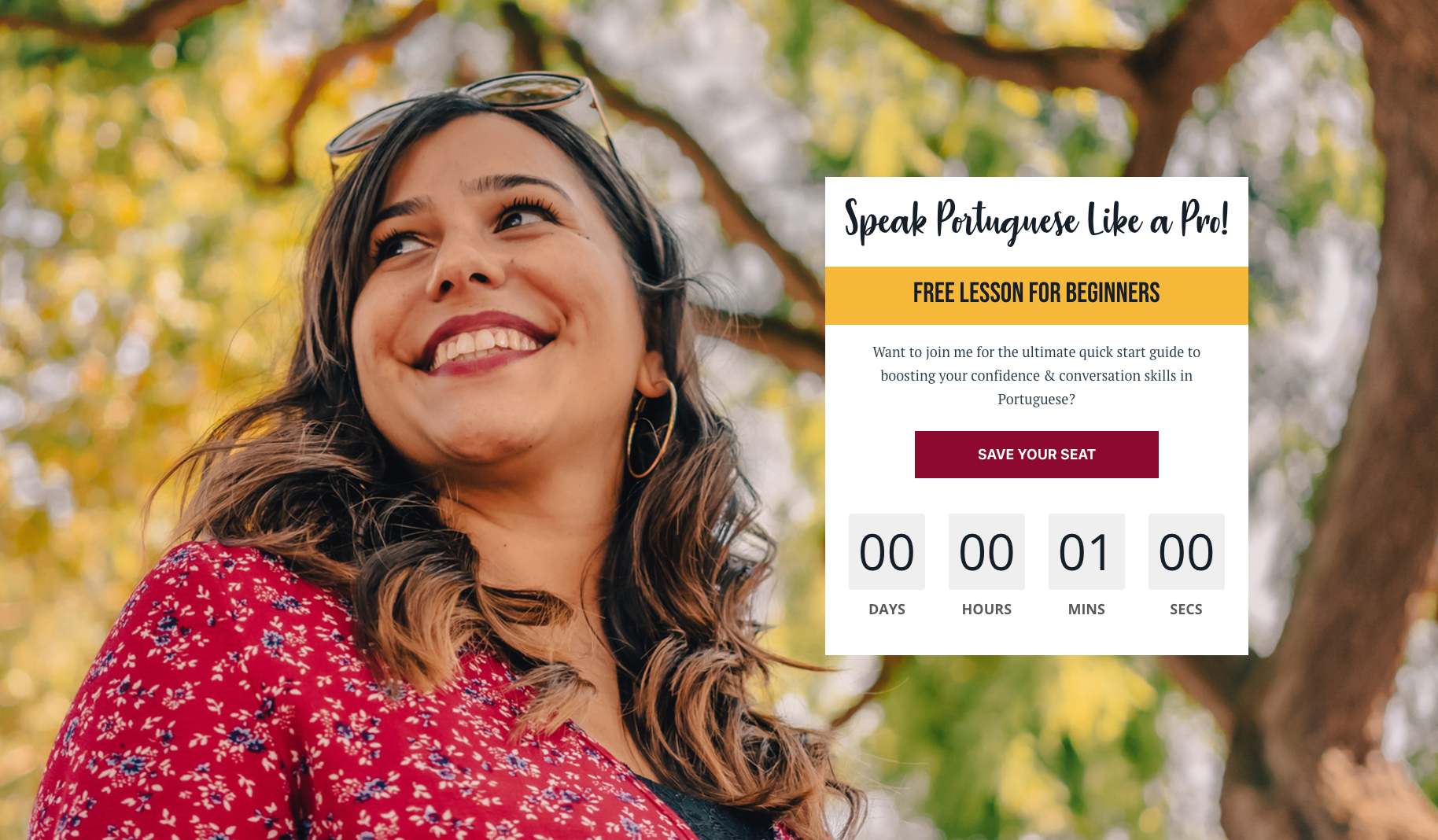
Want to see how Liz teaches first?
Her free training webinar shows you her approach before you commit to anything, and enrollment details for the course are shared at the end of it.
The short version
- What it is: a coached online course from Talk the Streets that takes you from zero to A2, the level you need for the CIPLE exam. More ↓
- What makes it different: pronunciation comes first, there are three live Zoom sessions a week, and real people correct your speaking and writing. More ↓
- The time it takes: Liz recommends two hours of independent study for every hour you spend with her lessons. More ↓
- After A2: graduates who pass the course’s final exam can join Fluency Fast Track, a separate program that goes up to B1. More ↓
- Exam prep: it ends with a full mock CIPLE exam covering all four parts, with scored feedback on your speaking. More ↓
- Who it suits best: anyone learning European Portuguese who wants to speak it, and especially anyone nervous about the CIPLE. More ↓
Where Do You Want to Start?
The basics
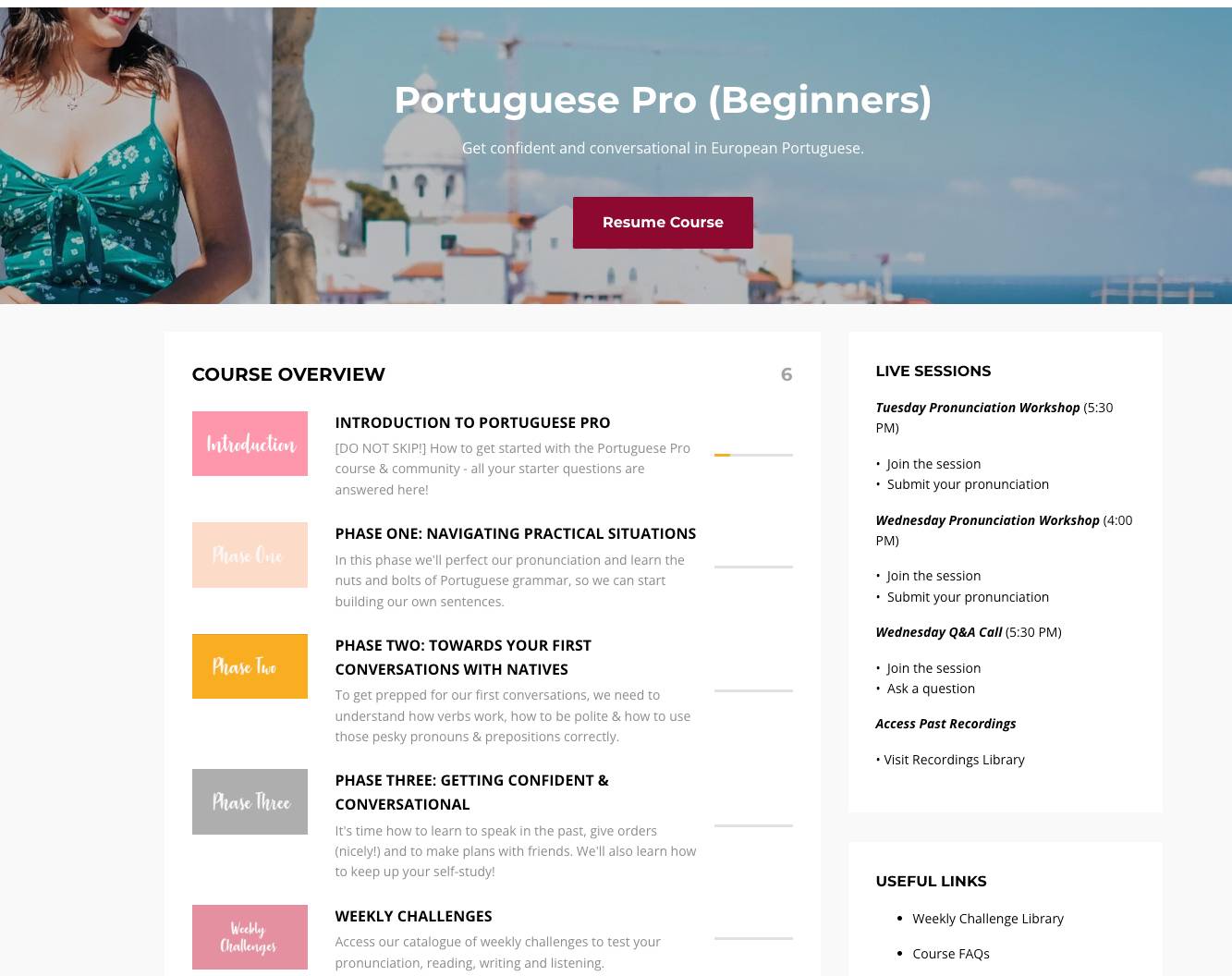
What Is Portuguese Pro?
Short answer
Portuguese Pro is a coached, video-based course that takes complete beginners to A2 level, the level tested by the CIPLE exam. It’s built around passing that exam, which is what most people moving to Portugal need it for.
Most courses do one or two of these things well. Portuguese Pro puts them all in one place:
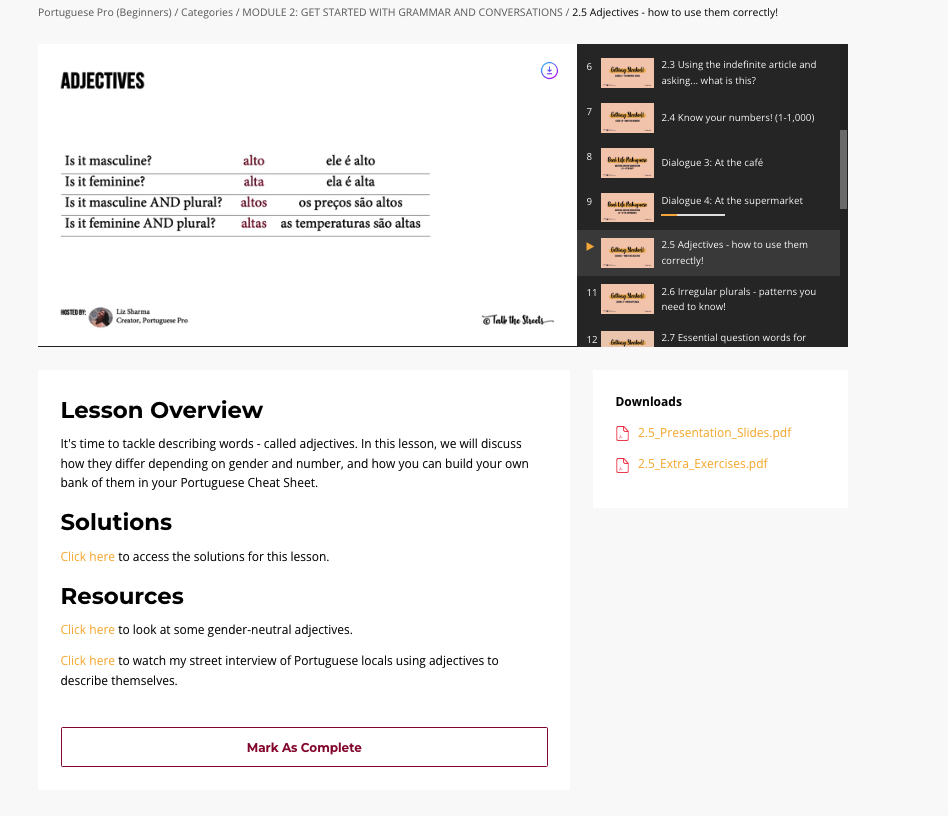
- Grammar lessons: video lessons that build up from the basics, introduced through real conversations rather than abstract rules.
- Pronunciation practice: eight lessons on sound, plus two live workshops a week where the team corrects recordings of you speaking. More ↓
- Dialogues: 16 scripted dialogues in natural, colloquial European Portuguese. More ↓
- Writing feedback: weekly writing challenges, corrected by the team.
- Speaking milestones: ending with a recorded 10-minute conversation with a native speaker.
- A mock exam: the TTS Final Exam, modeled on the CIPLE, with feedback. More ↓
At a glance
Portuguese Pro
✔ Zero to A2 (CIPLE level)
✔ Three live Zoom sessions a week
✔ Lifetime access
✔ Taught by Liz Sharma and her team
Portuguese Pro itself covers A1 and A2. If you want to go further, Talk the Streets now runs a separately priced follow-on program, Fluency Fast Track, which takes students from A2 to B1. More on that ↓
⏳
You can’t just buy it
Enrollment opens in windows, and the details are shared at the end of Liz’s free training. You apply, have a 45-minute call, and have to be accepted.
Talk the Streets keeps the community small and serious on purpose. Once you’re in, you have lifetime access.
The exam
How Does Portuguese Pro Prepare You for the CIPLE?
Short answer
Portuguese Pro ends with the TTS Final Exam, an internal mock exam modeled closely on the CIPLE. It covers reading, writing, listening and speaking, and the 10-minute conversation you record for Milestone 3 is the speaking part, so you don’t record it twice.
You need A2 for permanent residency after five years in Portugal and for citizenship, which now takes ten years for most nationalities and seven for EU and CPLP citizens.
It’s not unusual for people studying for the A2 to do well in reading comprehension but struggle with listening, speaking or writing. Portuguese Pro covers all four, and gives you feedback on them.
If you get through the mock exam, I think you have a very good chance of passing the real one.
💡
The course doesn’t certify you
You still need to book and sit the real CIPLE through CAPLE at the University of Lisbon.
Passing the TTS Final Exam is also what unlocks Talk the Streets’ follow-on program and immersion retreats.
The teacher
Who Is Liz Sharma?
Short answer
Liz Sharma is a British linguist who lives in Lisbon and created Talk the Streets, one of the most popular YouTube channels for learning European Portuguese. She studied Portuguese alongside Spanish at the University of Manchester and has spoken it for more than 15 years.

She started as a complete beginner, so she knows exactly where English speakers get stuck, because she got stuck there too.
At Manchester, she founded the university’s first Portuguese society. After graduating, she spent time in Brazil, then moved to Lisbon while working remotely in PR. She speaks both European and Brazilian Portuguese.
Talk the Streets started as a YouTube channel, filming real people on the streets of Lisbon and subtitling what they said.
One of her early videos that took off looked at how European Portuguese speakers drop sounds and run words together. That’s exactly what makes the language so hard to follow at first, and it’s why pronunciation is where Portuguese Pro starts.
I interviewed Liz about how she fell in love with Portugal and why she moved here. Read the interview with Liz Sharma →
The method
Pronunciation First, Speaking Throughout
Short answer
Portuguese Pro starts with pronunciation, not grammar. Module 1 is eight full lessons on sounds alone, before you meet a single verb table.
Most European Portuguese courses jump straight into grammar. Liz’s view is that getting the sounds right early is what builds confidence.
“Your confidence is about to skyrocket because we are going to cover pronunciation,” she tells you in the introduction.
Grammar arrives in Module 2, and even then it’s introduced through real conversations, not abstract rules.
Module 1
Eight lessons on sound
✔ Open and closed vowels
✔ Nasal vowels
✔ Vowel pairs
✔ Consonants, easy and hard
✔ Stress and intonation
✔ The alphabet
✔ How to keep improving on your own
Liz is friendly, speaks clearly, and makes difficult grammar feel approachable. The video format suits her.
She also asks you to write down at the start why you’re learning Portuguese and what your goal is. When things get hard, and around the verb tables they will, you have something concrete to come back to.
Commitment
What Does Portuguese Pro Ask of You?
The testimonials on her site are good. They come from people who moved to Portugal and started talking to their neighbors, their landlords, and the person at the café, because the course pushed them to.
If you’re serious about learning Portuguese, want accountability, and want the boost of learning alongside people with a similar level of determination, this course will take you from zero to actually speaking with locals.
💡
The course isn’t magic
Those people got results because they put the work in. As Liz puts it in the course introduction: “For every one hour you spend with me, you need to spend two hours learning independently.”
If you want a feel for how she teaches before committing, her free training webinar is worth watching on its own.
The structure
How Is the Course Structured?
Short answer
Portuguese Pro runs across three phases and six modules, with 16 scripted dialogues woven through them. Each phase ends with a milestone you submit to the team.
Phase One: the foundations
Modules 1–2. Pronunciation, then the building blocks of grammar.
Phase Two: everyday life
Modules 3–4. Verbs, the future tense, ser versus estar, and being polite.
Phase Three: past and future
Modules 5–6. The past tenses, the imperative, telling the time and making plans.
| Phase | What you learn | Dialogues | Milestone |
|---|---|---|---|
| One Modules 1–2 | Pronunciation, gender and articles, numbers, adjectives, plurals, question words, possession, likes and dislikes, prepositions | Meeting someone new · greeting a friend · café · supermarket · bar · restaurant | Send in pronunciation recordings |
| Two Modules 3–4 | Regular and irregular verbs, future tense, ser vs. estar, reflexive verbs, pronouns, being polite (tu vs. você) | Taxi · a polite conversation · phone call · clothes store · metro station · doctor | Find a language exchange partner and send proof |
| Three Modules 5–6 | Preterite, imperfect and past perfect, the imperative, telling the time, making plans | How was your trip · your weekend · plans this week · hotel check-in | Record a 10-minute conversation with a native speaker |
🗓️
The 30-day speaking challenge
The course opens with a challenge that runs alongside Modules 1 and 2. You learn one practical phrase a day, drill it for five minutes each morning, and stick it on a Post-it note somewhere you’ll see it.
You track when you’ve mastered it and when you’ve actually used it. It’s a small thing, but it gets you producing Portuguese in your first week.
The dialogues
Do the Dialogues Sound Like Real Portugal?
Why they matter
The dialogues are one of the strongest parts of Portuguese Pro, because they use the colloquial Portuguese you’ll actually hear in Portugal, not textbook Portuguese.
☕
Dialogue 3: the café
Opens with ordering a meia de leite and deciding which pastry to have with it.
🧾
Dialogue 4: the supermarket
Includes “Contribuinte na fatura?” (NIF on the receipt?). You’ll hear this several times a week, and almost no other course teaches it.
📱
Dialogue 15: weekend plans
Includes the slang bué complicada and ends with “Não olhes para o meu Instagram, vais morrer de inveja” (don’t look at my Instagram, you’ll die of jealousy).
🏨
Dialogue 16: hotel check-in
A booking error, a request for the manager, and a resolution. Complex Portuguese for what is technically a beginners’ course.
Each dialogue is labeled with the grammar it practices, so you hear what you’ve just studied used naturally.
The audio quality is very good, which makes them a great starting point. The CIPLE’s listening audio isn’t as clean. The exam makes it a little harder on purpose, so you’ll need to get used to rougher recordings too. Seven audio recordings broken down is a really good start, but I do think it’s worth listening to as much as you possibly can (whether that’s through podcasts, TV with subtitles, apps like Practice Portuguese, or YouTube if you’re able to find it with good subtitles).
Live feedback
What Are the Live Sessions Like?
Short answer
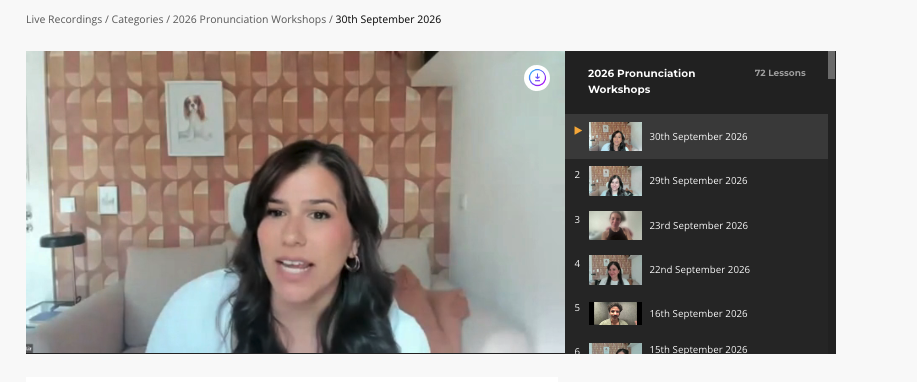
Portuguese Pro runs three live Zoom sessions every week: two pronunciation workshops and one Q&A call. This feedback loop is what almost every other European Portuguese course is missing.
🎙️
Pronunciation workshops
You send a recording through SpeakPipe beforehand, and the team corrects your specific mistakes live. Split into beginners (Modules 1–3) and improvers (Modules 4–6).
❓
Weekly Q&A
Open to any question about the course or the language. You can submit questions in advance, and you hear everyone else’s too.
🔎
Recordings library
Every session is recorded and searchable, so if a topic came up three months ago, you can find it.
Liz runs many of the sessions herself, and Eduardo and the rest of the team cover the others.
Hearing other people’s questions is one of my favorite parts of the course. It often answers things you didn’t know you needed to ask, so you learn from other people’s gaps as much as your own.
You can spend a year on a subscription app and quietly reinforce mistakes nobody ever points out. This is how Portuguese Pro avoids that.
Accountability
Milestones, Challenges and the Community
The milestones
Portuguese Pro has three milestones, one at the end of each phase. The last is a 10-minute recorded conversation with a native speaker, scored, with feedback within seven days.
Pronunciation recordings
Submitted at the end of Phase One.
A language exchange partner
Proof submitted at the end of Phase Two.
A 10-minute conversation
Scored, with feedback in seven days. Completing it earns the “Sou Pro” badge.
That final milestone is demanding. It’s also the closest thing to the CIPLE speaking component you’ll find before the real exam.
Weekly Challenges and the Community
Outside the lessons, weekly challenges cover speaking, reading, writing and listening. The writing challenges are the most useful: you get a short prompt, write a few lines, and the team corrects your mistakes.
Feedback on written Portuguese is almost impossible to find in a self-study course.
The community is organized by topic and searchable. Members share wins, ask questions and swap resources. The success stories are worth reading, if only because they remind you people at your level are getting there.
⚠️
You have to find your own language partner
The course requires a language exchange partner but doesn’t find you one. You get a list of resources and platforms.
Finding someone who speaks European Portuguese is harder than it sounds, because most people on exchange apps are Brazilian. Budget some time for it. The course requires it anyway, which is part of the point.
What’s next
What Happens After A2?
Short answer
Talk the Streets’ answer to “what next?” is Fluency Fast Track, a follow-on program that takes Portuguese Pro graduates from A2 to B1. It costs $1,500 up front, or three monthly payments of $525, on top of Portuguese Pro.
💬
Weekly conversation club
Live, in small groups, and scheduled around students’ time zones.
🎧
Ten new conversations
Between native speakers, with a range of regional accents, full transcripts and comprehension exercises.
📚
The grammar you haven’t covered
Including the subjunctive, the personal infinitive and the conditional.
You need to pass the TTS Final Exam to get in. It runs as a timed cohort rather than a self-paced course, so you move through it with a group.
The first cohort started on October 5, 2026.
At a glance
Fluency Fast Track
✔ A2 to B1
✔ $1,500, or 3 × $525
✔ Live group classes
✖ Timed cohort, not self-paced
✖ Pass the TTS Final Exam first
You don’t have to do your B1 with Talk the Streets. Lots of other courses cover B1, and you could move on to one of those.
But if you like how Portuguese Pro works, Fluency Fast Track is how you stick with it. Either way, I think B1 is definitely worth getting.
Students who pass the exam can also join small immersion retreats in Portugal. They’re still an experimental extra, but they’re a nice option if you’re already here and want to push further.
The price
How Much Does Portuguese Pro Cost?
Short answer
Talk the Streets doesn’t publish the price of Portuguese Pro, and “premium” is the best way to describe it. Depending on what you compare it with, it can cost twice as much as other online courses and apps.
| Course | Level | Price | Format |
|---|---|---|---|
| Portuguese Pro | Zero to A2 | Not published (shared after the application call) | Video lessons, live sessions, lifetime access |
| Fluency Fast Track | A2 to B1 | $1,500, or 3 × $525 | Timed group cohort |
Compared with in-person classes, it’s not out of line. But some online courses and resources take you to B1 or B2 for the same money or less, while Portuguese Pro on its own stops at A2.
The price does mean the people around you are serious, which helps. It also means the course isn’t affordable for everyone.
I’d still rather pay for a course that actually got me to A2 than for one that could, in theory, get me to C1 but that I never opened.
Verdict
Verdict: Is Portuguese Pro Worth It?
Is Portuguese Pro worth it? Yes.
It’s the most well-rounded European Portuguese courses I’ve come across. It covers speaking, listening, reading and writing, and it gives you real feedback on the parts most courses skip.
The pronunciation feedback is the biggest one for me. I know I make mistakes I can’t hear. I’ve listened, read and learned things wrong while believing in my head that they were right.
The only real fix for that is someone correcting you, and this course does.
The writing feedback is good too. You can do lots of courses and never write anything. Most people don’t write much in Portugal day to day, but writing is part of the exam, and here someone actually corrects it.
And it makes you speak. Technically, any course can tell you to speak and find a language partner. This one actually makes you, through milestones you have to submit.
If you’re serious about passing the CIPLE, the mock exam is the most important part. It’s the one course I know of that gives you a full mock exam and feedback on it. If you get through it, you’re in a strong position for the real thing.
The live sessions, the workshops, the milestones and the community all push learners past the point where most courses leave them: knowing the language academically but being too unsure to use it.
That matters. The difference between living in Portugal and actually being part of life here is mostly a speaking-confidence gap, and this course addresses it more directly than anything else I’ve seen. If you’re looking to seriously learn European Portuguese, this is a solid course to consider.
What I’d Like to See
There are things I’d like to see. More dialogue, for one. It would also be nice if the course paired you with a language partner, although finding one is part of the journey of learning a language.
Optional one-on-one sessions with Liz and her team would take you further still, with feedback on your pronunciation and on what you’ve studied in the course.
If you’re used to an app like Duolingo, you might wish it were more app-based. A lot of people are looking for a way to avoid speaking practice and grammar. Unfortunately, if you want to learn a language, you can’t avoid either.
Portuguese Pro will take you to a solid A2, and I think people will be very happy there’s now a way to reach B1 with the same focus.
The extra $1,500 does make getting to B1 more expensive than with most other courses, many of which include B1 material. That doesn’t mean those courses will get you there, though. The quality of the course matters too.
I’d like to see it go up to B2 eventually. I hope that’s coming, but it isn’t here yet.
I’d recommend Portuguese Pro to anyone learning European Portuguese who wants to speak it in Portugal, and especially to anyone who’s nervous about the CIPLE.
 Thinking about Moving to Portugal?