
The A2 Portuguese Test (CIPLE): Courses and How to Pass
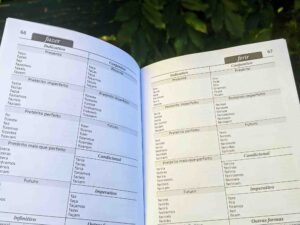
An open book displays verb conjugation charts in Portuguese. The left page shows conjugations for the verb "fazer," and the right page shows conjugations for the verb "ferir." Both pages include various tenses and grammatical moods. Green leaves are visible in the background.

If you’re applying for Portuguese citizenship or permanent residency, you almost certainly need to prove you speak Portuguese at A2 level. For most people, that means sitting an exam called the CIPLE. Thankfully, there are several courses that cover it in depth. Liz Sharma’s Portuguese Pro even includes a mock A2 exam, which her team corrects. If you’re feeling uncertain about where to start, her free training is a good first step. Practice Portuguese has more European Portuguese audio than …


Read more

How to Get Portuguese Citizenship Through a Spouse or Partner

Two barefoot children dressed as bride and groom sit on wooden steps, playfully interacting—likely at a celebration in Portugal.

Yes, you can get Portuguese citizenship through your spouse. And—the part people don’t realize—you can get it through a long-term partner you’re not married to, through a união de facto. Both are three-year routes, and neither requires you to live in Portugal to apply. The other thing worth clearing up early: you don’t actually need citizenship to move to Portugal. If your spouse or partner is Portuguese, or a citizen of any EU or EEA country or Switzerland, you can …

Read more

Can You Get Portuguese Citizenship Through a Great-Grandparent? Yes, But It Isn’t Straightforward

A hand holding a Portuguese passport in front of a blurred background resembling the colors of the Portuguese flag, green and red.

Most weeks, someone emails me a version of the same question: my great-grandmother was born in Porto—can I get a Portuguese passport? It comes from all over—Canada, the UK, Australia—but far and away the most often from the United States. People who never used to think about a second passport suddenly want the option, and a great-grandparent from the Azores or mainland Portugal looks like a route in. So here’s the direct answer. You cannot claim Portuguese citizenship by descent …

Read more

How to Get Portuguese Citizenship: The Main Routes Explained

A hand holding a Portuguese passport in front of a blurred background resembling the colors of the Portuguese flag, green and red.

Portuguese Citizenship · 2026 Portuguese Citizenship: Every Route Explained Interested in obtaining Portuguese citizenship? We break down every route for living here to marriage, as well as all the requirements for each. By James Cave, founder of Portugalist·Get in touch Why people want it One of the most sought-after citizenships in the world For good reason. It isn’t just a Portuguese passport — it’s full European Union citizenship, with everything that comes with it: the right to live, work, retire …

Read more

Obtaining Portuguese Citizenship Through Your Parents

Smiling elderly couple on a sunny street in Portugal; woman with glasses, green scarf, man with brown cap and green striped shirt.

If one of your parents is a Portuguese citizen, you have one of the strongest possible claims to Portuguese citizenship. Under Portuguese nationality law, this is known as citizenship by attribution (atribuição da nacionalidade) — meaning you are treated as Portuguese by birth once the process is completed, rather than having to “earn” citizenship through residency or other conditions. This is the most direct route to a Portuguese passport and, with it, the right to live, work, and travel freely …

Read more

Obtaining Portuguese Citizenship Through a Grandparent

Smiling elderly couple on a sunny street in Portugal; woman with glasses, green scarf, man with brown cap and green striped shirt.

Millions of Americans and Canadians have Portuguese grandparents — particularly from the Azores (Açores), Madeira, and mainland Portugal — and may have a valid claim to Portuguese citizenship without fully realizing it. This route is more involved than applying through a parent, but it is a well-established legal pathway and many people successfully complete it every year. The formal name for this application is a nationality registration by descent (registo de nacionalidade por descendência), and it requires you to document …

Read more